Showing posts with label Video Games. Show all posts

Friday, August 22, 2014

Elysian Shadows: Interview With The Artists Part 2 (Leandro Tokarevski)


This song has nothing to do with game, but as I already shared Connor Linning's work on the game I figured I'll share music I'm enjoying a lot from a different indie game, Electronic Super Joy: Groove City! I love this song, and the whole soundtrack. EnV did a great job.

This is a continuation of my previous interview with Patryk Kowalik, this time featuring the game's other artist Leandro Tokarevski! Read the previous interview, and get details on the Kickstarter itself, here.

The Logbook Project (tLBP): So let's start simple: who are you and what is your role in the Elysian Shadows team? I'm interested in general information as well as your history with regard to art, and specifically pixel art.
What sort of programs do you use for making the assets for the game?
Leandro Tokarevski (LT): My name is Leandro Tokarevski, I'm a pixel and concept artist for Elysian shadows, as well as a level designer. I'm half Italian and Half Russian, I was born in Rome, and now live mostly in St Petersburg, Russia. I've always loved drawing and painting, when I was 11 I entered an evening art school and then went on to entering the academy of arts of St. Petersburg, I'm about to start my fifth year studying architecture. Despite drawing for so many years, I've only relatively recently delved into pixel art, Elysian Shadows is my first real pixel art project. It's been an interesting experience, learning the specifics, but I found that most of the techniques used in traditional art were just as valid in pixel art, so it wasn't hard to adapt. I use GraphicsGale, Adobe Photoshop, and more recently Spritelamp. I find GraphicsGale is the best program for more old-school pixel art and animations, but ES has ventured so far from the classical 16-bit RPGs it was inspired by in terms of visuals, and gameplay for that matter, that its features are simply insufficient for our game. The addition of Spritelamp really helped develop ES's visual style, I'm still figuring out some of the details, but I'm pretty sure that with the help of Photoshop and Spritelamp We'll develop an atmospheric and unique art style. We're really doing things nobody really did on such a massive scale with pixel art.
tLBP: I absolutely agree that traditional art techniques are often just as useful to pixel art. When I'm working with pixel artists almost half of what I talk about is more fundamental general art concepts, with the other half being specific pixel-art techniques. I also agree about GraphicsGale's excellence as a program for standard pixel art - I don't use it personally, but along with Pro Motion it's the most robust pixelling program I know of. It's really interesting that ES is unique enough that GG wasn't enough. Having watched the video about SpriteLamp Patryk put out a few days ago though I can totally see how unlike anything else SpriteLamp is. It's a great piece of unexplored technology that I underestimated originally.

tLBP: Can you tell me something about how the process works between you and with the rest of the members of the team?
LT: I usually am given to design and draw an entire area of the game at the same time, along with all of its enemies, the architecture of the towns and dungeons, so everything in it is consistent and the designs are similar and work with each other. The team has a huge (and secret) design document in which all of the lore, characters, and environments are described, so before creating any assets I go there and read what exactly the area of the game is about. After that as long as I stay true to what's in the design doc, I have pretty much carte blanche, and can invent pretty much anything. We have a team chat on Skype, in which we discuss all of our ideas and suggestions. Once an idea is approved, I can go ahead and draw it out in pixel art. Sometimes, when the team chat is not enough, we have a team hangout where we brainstorm ideas and figure stuff out. It needs to be planned in advance, because we're all in different time zones. It isn't uncommon for us to have a hangout when for someone it's 4am.

tLBP: I don't have experience with pixelling for game development, but I always hear about how restrictive the time crunch can be in creating the art. How much time do you reasonably take on a single asset (a background, a character and their animations, whatever)? Are you often forced to work with the first draft of a piece or do you get much chance to go and revise before moving on?
LT: It's only me and Patryk creating assets for ES, and the amount of stuff that needs to be drawn is sometimes overwhelming. Most times when creating a tilesheet or a sprite we skip the concept art stage entirely and start drawing pixel art right away, speeding up the process. This sometimes backfires, however, if there's a miscommunication between team members during the discussion phase, and sometimes we end up repixelling something we spent a lot of time into. After the kickstarter we'll finally have enough time to draw concept art first, and then go into the pixel art. I'd say on average a tilesheet for an environment of the game will take about 15-20 hours to complete, it varies from area to area, though. Same with sprites, it depends on the kind of creature. A stone golem will take less time to animate then a living breathing creature. The time crunch was particularly restrictive on the last weeks before the kickstarter campaign launched. So much work needed to be done, that there was barely any time for discussion. Now the pace of work has slowed down a bit, thankfully.
tLBP: I don't have a metric for if 15-20 hours really is a huge amount in game develoment, but it certainly sounds like a lot! Glad that the pace is starting to slow a bit though, seeing more refinement will be really cool.

tLBP: How indicative of the game's look are the Kickstarter photos? I gather that the asset quality will continue to be upgraded, but is there anything style-wise thatyou think will change from the current look?
LT: I'd say the kickstarter screenshots are barely representative at all at this point of how the game is going to look like when finished. Since we decided to use Spritelamp and to draw normal maps by hand, our process for creating pixel art has changed completely. We no longer have to put shadows on to sprites and tiles themselves, we draw a normal map that when implemented in the game will create lights and shadows automatically. This is such a fundamentally different and new approach of creating pixel art, that we'll have to redraw and rework every single asset we currently have, so I'll say that 99% of what you see on the kickstarter page will look different in the actual game. Actually no, make it 100%.
tLBP: Wow! So the general aesthetic (perspective, etc) will be pretty similar but everything will be redrawn using Sprite Lamp's normal mapping? I'm really excited to see hwo the areas start looking when you get whole regions fully built with the normal maps, I bet that'll be really impressive.

tLBP: A big change to the way pixel art works in games comes from the lighting engine the game will be using, SpriteLamp. Can you tell me something about how that technology works and how it changes the creation of art assets?
In my own experience, a consistent lightsource is an important part of making a pixel piece seem cohesive. How do you make the base art that SpriteLamp will then work on while still trying to produce good assets on their own?
LT: When we first experimented with Spritelamp, creating up to 5 lighting profiles for every single asset, first of all it took way to much time, it would become impossible for us to ever finish all of the artwork for ES, and secondly the normal maps that it created weren't even that accurate and looked off most of the time. Patryk then had the idea of drawing all of the normal maps directly by hand. He explained to me how it would work, and it just made sense. We would start by drawing a diffuse map, basically a drawing without any shadows, where the light comes from every angle. Then, we would draw a normal map by hand in Photoshop, so that it would look exactly the way we want it. Then if needed we would draw depth maps and ambient occlusion maps, and feed it all into Spritelamp. The results are fantastic, and it doesn't take that much more time than drawing traditional pixel art. It's sometimes even quicker. When a dynamic light hits an object it comes to life, it looks three-dimensional, and exactly the way we want it to look, while still looking like pixel art, since we can regulate how many shades the dynamic light will be divided into when it hits the object. 5 seems to work best. As far as I know nobody ever used such a method of drawing pixel art, I'm sure we'll learn more along the way on how to perfect it, but even now we already fixed basically all of the issues traditional pixel art had with dynamic lighting.
tLBP: One of my initial concerns with using SpriteLamp was that the outputted normal maps on Sprite Lamp's own Kickstarter page looked pretty unimpressive to me, but manually creating the normal maps has seemed to really show the true power of the program, as shown in some of your recent content. Being able to regulate the shades is interesting too, I didn't know you had that control. Did having more shades just not hold enough of that "pixel art" look or something? It's also really interesting that it's not any slower to do it this way. I'll have to try it sometime!

tLBP: The game is going to be run on a variety of systems. SpriteLamp is native to Windows, and has plans to work with Mac and Linux, but are there special considerations you need to accommodate for it to function on Dreamcast/Android/iOS? Should you reach the Xbox One/PS4/Wii U stretch goals I'd imagine those consoles are strong enough to handle it, but the relative power of the mobile OSs seems like it'd be an obstacle.
LT: That's not really my area of expertise, but from what I heard from Falco, the Dreamcast is just about capable of handling what we create with Spritelamp. I really hope the programmers will find a way to implement the light engine on all of our platforms, I really don't know if that's possible and what it would entail.
tLBP: Patryk was confident that the systems were more than capable of handling it, which is very exciting.

tLBP: Still on the topic of the other operating systems, are you doing anything special to make it look great both at the small resolutions of mobile units as well as on large monitors or televisions with the PC/Mac/Linux/Dreamcast? Will it be a matter of scaling the assets, or some other solution?
LT: The resolution of the game right now is 720p. I would personally prefer it to be a little lower resolution, because right now the character sprites are really small on screen, and sometimes we show a little too much of the map at the same time. The pixel art suffers a little too, making the grid-like patterns of the tiles more apparent, but I digress. We'll scale all of the assets to match 720p, or whatever resolution we decide on. It just doesn't make sense to make a full HD pixel art game. It's better to just zoom in. Pixel art looks better zoomed in anyway. :)
tLBP: I agree in a lot of cases about zoomed-in pixel art. And full 720p doesn't actually add that much precision to pixel art. Especially if emphasizing the pixel-art look is the goal, a bit lower might be preferable. As you've said though, ES's pixel art isn't quite like any other pixel art, so it'll be interesting to see how it behaves.

tLBP: This is a long ways out, but about the Next-Gen+ stretch goal: will that high-end graphics setting be an entirely remade set of assets or just upgraded capabilities (physics etc)?
LT: It will have the same set of assets as the regular game, just upgraded features. Not sure exactly what though, it's still a little early to decide, I'd rather wait for us actually reaching that stretch goal!
tLBP: No problem, that covered what I was interested in! Thanks for all your time - these answers have been really in depth, so I can't actually think of any additional questions! I'm really excited to see how the game develops. Good luck on the final leg of the Kickstarter, and I hope that even should you miss the goal that we haven't heard the last from you yet! I'm rootin' for ya. :)

The game is only $4000 away from funding! A great burst in these last ten days has taken the game out of the scary uncertainties of the middle point of the campaign.

End Recording,
Ego.

Sunday, August 17, 2014

Elysian Shadows: Interview with the Artists Part 1 (Patryk Kowalik)


Connor Linning, the ES team's musician, has all the music set to no-embeds, so have a video of one of his own OTHER songs! Check out his soundcloud account, or the playlist you can find on their Kickstarter page. It's actually really nice sounding. The game's main theme sounds great.

Part 2 of the interview, with Leandro Tokarevski, can be found here!

Hello, welcome to my brief foray into becoming a member of the gaming journalism press. Let's get to it.
Image taken from the Elysian Shadows Kickstarter page.
Travel through lush environments and diverse biomes, exploring a series of mysterious ruins, and discovering a world caught in constant conflict between magic and technology. Magic is a gift reserved for only the loyal followers of The Creator, while the non religious sects of society are forced to rely upon technology in their daily lives. Upon uncovering a mysterious artifact deep within one of the ancient ruins scattered throughout the land, Julien and friends find themselves thrust into the middle of this rising conflict. Can you solve the mystery of the ancient civilizations and prevent the destruction of your own?
Elysian Shadows is an indie 2D RPG being developed for Windows, OS X, Linux, Android, iOS, Ouya, and even the Sega Dreamcast (not even kidding). We fuse aspects of 16-bit classical RPGs with a highly stylized, modern vision by using dynamic lighting, physics, and audio engines along with swapping between 2D and 3D perspectives. Our goal is to create the "next-generation" of the 2D RPG in terms of gameplay, graphics, and audio. We want to reinvent and revitalize the aging genre for a new generation of platforms, while still remaining true to the 16-bit charm of the SNES and Genesis classics that we all grew up loving. 
Those are the opening blurbs of the Elysian Shadows Kickstarter, which has been going on for two-and-a-half weeks now. A friend of mine showed me their campaign, spurred on by their own love of the Dreamcast, and I had a bunch of interesting thoughts about it. Most importantly, I noticed the distinct appearance of the art. Here's a couple pictures to illustrate.
In-game captured GIF In-game screenshot
In-game screenshot

These are some in-game screenshots presented in the KS. So if you're a veteran of my Pixel Art Lessons, or if you're just a frequent pixel-artist yourself, you might notice some stuff. I did. I then talked about it a lot on twitter, like on three separate days for an hour each, which is a lot of talking. Most of it wasn't particularly favorable, though not mean-spirited, especially in light of both of the artists being relatively new to pixel art but also in light of the struggles of making assets for game development as opposed to gallery-style work.
I had so many thoughts that I decided I should just figure out more about how it works with them from the artists themselves! So I reached out to Falco and he put me in touch with Patryk, the lead artist. My questions have also been sent to Leandro, but he's on holiday with family in Italy right now, so I'll put up that second half of the interview later.
The format for the interview was I emailed a bunch of questions, received the answers, then fired off a couple follow up questions. For smoothness purposes I'll be integrating the follow-up questions where I they make sense to be.

The Logbook Project (tLBP): So let's start simple: who are you and what is your role in the Elysian Shadows team? I'm interested in general information as well as your history with regard to art, and specifically pixel art.
Patryk Kowalik (PK): I'm Patryk 'Imrooniel' Kowalik and I'm lead artist art ES team. Joined close to 3 years ago, initially as concept artist but when I saw that we're severely lack actual game assets I picked up pixel art. We all are wearing multiple hats, so I'm also writing a ton of lore and world building.

tLBP: What you think of pixel art as a new artist? I'm frequently involved with the teaching of relatively new artists, so how new pixellers start out and how they teach themselves or learn the craft is really interesting to me.
PK: I know I'll be stoned by pixel art purists for this answer, but it's just yet another category of art styles for me. Just like vector art, hand painted... But I think that's what allows me to come up and mix in new things like normalmapping - there's nothing sacred for me in pixel art, so I'm not afraid to experiment with it.

tLBP: Have you done any work outside of the assets for Elysian Shadows, whether elsewhere or more likely just for fun?
PK: Actually I've been freelancing artist for over past two years, since high-school. I've worked on quite a few projects - most of them never got finished unfortunately.
(here, my portfolios if you want: http://imgur.com/a/uXpIZ#0 and http://imgur.com/a/B22KY#0

tLBP: What sort of programs do you use for making the assets for the game?
PK: Photoshop actually, I know it's not the best program for pixel art out there, but I've been using it for past 8 years and it works. Also Spritelamp to check out normalmaps.

tLBP: Can you tell me something about how the process works between you and with the rest of the members of the team?
PK: Well... I'm making a map, post progress as I go on forum and once I'm done with all the major points (ground, walls, and big structures) I give it up for our level designer for testing. Because we're using a lot of tile flipping and rotation, sometimes it is confusing to build out of the tilesheet at first sight, so that's a time to spot it and add any additional comments.

tLBP:I don't have experience with pixelling for game development, but I always hear about how restrictive the time crunch can be in creating the art. How much time do you reasonably take on a single asset (a background, a character and their animations, whatever)? Are you often forced to work with the first draft of a piece or do you get much chance to go and revise before moving on?
PK:Honestly, crunch is result of poor management and planning. So far we could work at our own pace, with only minor hiccup just before Kkickstarter - but that's because we were trying to get as much done as possible before KS. We're not corporate, so we don't have to bother the rigid structure and methodology: I have a general time-line as to what should be completed until when, but it's more of an approximation. So far we're ahead of the plan, that left me some extra time for RnD.
tLBP: It's also very encouraging to hear that you're ahead of the game when it comes to time management!
Patryk pointed me at their brand-new "Adventures In Graphic Design Chapter 1" which illustrates how SpriteLamp and pixelling for the game works, and it's on its own the most understandable explanation of how SpriteLamp works I've seen yet. Check it out here:
tLBP: How indicative of the game's look are the Kickstarter photos? I gather that the asset quality will continue to be upgraded, but is there anything style-wise that you think will change from the current look?
PK: Quite indicative. There are some things that can be easily tweaked - perspective, scaling, shaders... But the art style itself will remain pretty much the same. I'm actually trying out different approach as we speak - one where shading is entirely dictated by normal map and not colour map. The result should be similar to what we have now - after all, I'm quite fond of what we have, except all lighting will be dynamic - not just overlay cast shadows.

 tLBP: A big change to the way pixel art works in games comes from the lighting engine the game will be using, SpriteLamp. Can you tell me something about how that technology works and how it changes the creation of art assets?
In my own experience, a consistent lightsource is an important part of making a pixel piece seem cohesive. How do you make the base art that SpriteLamp will then work on while still trying to produce good assets on their own?
PK: Well, normalmapping works by changing the way surface's normals interact with dynamic lighting. With it, we can simulate a volume to some extent, by making it in pixel art style, we can have pixel art that dynamically reacts to light. I actually spent last 5 days painting normalmaps by hand and trying different approaches - I'm trying to balance how much details I'm putting into normal map and how much into colour map. Different shaders also drastically affect the way it all looks.
To be honest, it's not quite a pixelart any more. We're using a lot of techniques from 3d modelling, experience from traditional painting and illustration and apply it to pixelart. What's the result if not pixelart? I have no idea, probably something in-between everything.
tLBP: That's really interesting to me. It may not be pixel art in the purist's sense, but that doesn't really mean anything except to the medium's connoisseurs. Forging new ground with how pixel art is manipulated and what it can be capable of using other techniques is really interesting, and one of the things that most interests me about the game.

tLBP: The game is going to be run on a variety of systems. SpriteLamp is native to Windows, and has plans to work with Mac and Linux, but are there special considerations you need to accommodate for it to function on Dreamcast/Android/iOS? Should you reach the Xbox One/PS4/Wii U stretch goals I'd imagine those consoles are strong enough to handle it, but the relative power of the mobile OSs seems like it'd be an obstacle.
PK: Spritelamp is just a tool for normalmap generation. Just like Photoshop - it doesn't affect on which systems our game will be played.
But as for dynamic lighting - it all works on dreamcast. Today's mobile devices and consoles are little bit more powerful than that, so I don't think there will be any issues

tLBP: Still on the topic of the other operating systems, are you doing anything special to make it look great both at the small resolutions of mobile units as well as on large monitors or televisions with the PC/Mac/Linux/Dreamcast? Will it be a matter of scaling the assets, or some other solution?
PK: It's mostly scaling, and we're using "nearest neighbour" so there wont be any issue with pixel art.

tLBP: This is a long ways out, but about the Next-Gen+ stretch goal: will that high-end graphics setting be an entirely remade set of assets or just upgraded capabilities (physics etc)?
PK: Emm.... do you mean new-game+? That's just a different game mode...
tLBP: That was in reference to a different higher-up stretch goal - as the stretch goals are no longer visible on the KS page I don't recall what the dollar amount was. Regardless, it was so high that it seems very unlikely to occur, so the question is irrelevant at this point anyway.

tLBP: Do you see yourself continuing with pixel art as a medium when you're done with the game?
PK: Definitely. It remains a cheap and affordable art style (well, relatively to everything else), so devs will still request it. Plus, you know, if Elysian Shadows' reception is going to be good, then we're definitely making expansion ;)

I want to thank Patryk and the Elysian Shadows team for taking their time with me and for being so openly transparent in general with all of their development on the game. Their regular livestreams and extensive documentation on Youtube is really impressive and respectable. You can see the Adventures in Graphics Design video above, but you should check the rest out. Check out the rest of their Youtube channel here.

And once again, their Kickstarter is still going here. Come support these developers!

Part 2 to this Interview, with Leandro Tokarevski, will be posted once it's completed.
End Recording,
Ego.

Thursday, July 31, 2014

Midsummer '14 Day 30 & Watch Dogs Revew: Rise Against - Help is on the Way

Not late so much as delayed, I was writing this thing and the deadline slipped by.
DAY THIRTY:  RISE AGAINST - HELP IS ON THE WAY

This song is by Nickelback-clone Rise Against. Rise Against is not a particularly good or bad band - they are at best competent and at worst trite and dull. This song is among their competent ones.

So if they're insignificant, why do we care? Because it's also one of the only interesting songs on the Watch Dogs soundtrack.

VIDEO GAME REVIEW: WATCH DOGS
Watch Dogs is a Ubisoft cross-generation video game that came out in May. It was met with great anticipation after solid showings from trailer footage and pre-release hype. Of course this is all a wind-up for the punchline:
The game sucks.

Okay, that's not precisely what I mean. Instead, the game passes every basic competence test while failing every single test for excellence. The game is thoroughly and universally mediocre.

Let's start with the all-important plot. I didn't get all that far, through the middle of Act 2 before returning my rental copy, so I won't judge it based on the ending but based mostly on the impressions the game gives to a new user.
You are Aiden Pierce. You were a dude who has a criminal past, but you've tried to put that behind you. Then all of a sudden your beloved niece is the victim of seemingly random violence in a car attack that you managed to live through. You get involved with the underworld again to try and hunt down the culprit, despite the ubiquitous surveillance.
Did I mention the surveillance? The setting is a near-future Chicago in which a single system controls watches every part of Chicago, maintaining a rigorous database of every single person in Chicago. Aside from the fact that even in the growing surveillance-state nature of the states, this would not be the route taken (as it provides the same weakness the game preys on - a single exploit would unlock the whole thing), it's aware to an almost silly level. In fact, scanning every single person in the city, the only one who comes up "unknown" is, well, Aiden Pierce. Even though his absence is kind of conspicuous - every single cop should immediately know to stop him if he's in view of any camera.
Aiden is a hacker (though a rather poor one if I do say so, in spite of how great we're told he is), and has gained access to the system that now controls literally everything in Chicago. The system, dubbed CTOS, controls every single digital interface in the city, and Aiden has cracked it. Hooray.

To hunt his niece's killers, we're opened into the game with him beating and terrorizing a man who ultimately doesn't know much of anything, hanging out with a renowned fixer. He seems to spout some kind of "I'd rather not kill" philosophy, which is immediately thrown away. In this game, you will kill hundred of people - ordinary gang members, agency workers, security forces, cops (an infinite supply of cops), anything. The game's tagline is "Hacking is your weapon" but it's not, your collapsible baton and  your silenced pistol and your sniper rifle and your grenade launcher and your automatic shotgun and your grenades are your weapons.
Does that sound like a lot of high-grade guns for later in the game? Nope. I had 'em three missions in, because everything opens up immediately. No, wait, actually things open up halfway through Act I, then there's literally nothing that seems to be locked off. You can do all the side missions, unlock everything, get every weapon and car, reveal the whole city, do literally everything that isn't directly a story mission. There's no real sense of the game pacing things out.
And if things seem like they're expensive, well, no problem! One of Aiden's tricks is that he can drain the bank accounts of the people he meets on the street! Not everyone though. Only some people can be drained, and they're usually the people with, like, one or two hundred in their account at most. You're taking the poor for what they have. And since you get a little blurb of insight into the life and occupation and income of every single person you see, you feel bad for people. Especially when I'm told that I'm robbing people in situations like "Taking out a second mortgage" and "Recently laid off" and "coming from family's funeral." Maybe its just me, but when I was playing this with friends, there was a trend toward the people you can steal from already being down on their luck.
And this isn't just something you the player know - Aiden knows it too. So what do we have so far? Aiden is a murdering vigilante using the mass surveillance but not breaking it down, robbing ordinary people down on their luck to fuel his crusade against what at first could only have seemed like random violence.
So he acts like he's doing this to bring peace to his niece's mother and brother, the latter of which has PTSD as a result of the loss. Oh, but he's doing it against his sister's wishes, who just wants him to let it go so they can heal and try and move their lives forward. Instead he gets them caught up in it and makes targets out of them.
And Dead Cell! Dead Cell is fictional Anonymous, hacktivists against the surveillance state. Oh except these guys actually seem to be behind virtual (and perhaps physical) terrorism.

So okay. Aiden is a vigilante, willing to kill anyone and everyone in his way to get vengeance for a single murder, falling in with virtual terrorists while taking advantage of the surveillance state they are also fighting, working with criminals who are mostly killers themselves, robbing average civilians to buy automatic weapons and fancy sport cars, and putting on a batman voice and pretending to be in the right this whole time.
And this is the protagonist.

Aiden is not a likable character by any stretch of the word. He doesn't even have that lovable charm of most anti-heroes and he's an asshole to his former friends (he has no current friends). In any other game, this is the man you're stopping!
The game tries to wrap itself in an anti-surveillance-state PRISM-is-bad message, and while I didn't see the end myself, I'm told it kinda handles it ham-handedly.

So what about the gameplay? Is it fun at least? Not particularly. Lots of driving everywhere, except the driving's not particularly fun. The controls are loose and the for a seemingly-realistic traffic flow, the lack of turn signals alone kinda screws with the flow. Turning is a bear, even with the best-handling tightest-turning motorcycles. I stopped using cars fairly quick and relied on just motorcycles - much easier, plus you can just ignore the traffic and blaze your own path through the streets. Hell, getting hit isn't even that bad, you just get thrown from the bike.
You can hijack every single car in sight, but because the game wants you to use the phone's Cars On Demand app that orders a vehicle to near your location (for free at least) there aren't very many parking spots let alone cars parked in them. Chicago is apparently a city of people driving but never parking. And because the Cars On Demand app always puts it somewhere in a lot or on the street near you but not right AT you, it's often a hassle.

The stealth gameplay wasn't that bad, but not exceptional. I'd play, well, any other cover-based stealth game as soon as Watch Dogs. Even The Last Of Us, which while I loved its plot and characters found its gameplay slow and unsmooth, was far more effective. I personally made it a bit harder on myself because I didn't like killing people in Watch Dogs (I interpret the melee takedown as nonlethal), but even if I wanted to use my guns there's only one silenced pistol as well as a silenced uzi that's hidden behind a pretty extensive unlock requirement.
And god help you if the cops find you. They're everywhere, spawn from everywhere, are fast and smart and call in helicopters pretty quick, and it is literally impossible to fight your way out, as they spawn infinitely until you hide and they give up.

The soundtrack is varied, but none of it is particularly noteworthy. Passable, but not exceptional. None of the voice acting is awful, though Aiden's gravelly grumbling is just, like, whatever.

The graphics are okay, though the debacle with the PC version's graphics is just ridiculous. Even on next-gen they're really not the revolution they'd been talking about, but they're still good.

So the plot's early game sucks, the protagonist is supremely unlikable and hard to root for, the driving sucks, the stealth sucks, the guns are whatever, the soundtrack is whatever, the graphics are good but not exceptional, is there anything I really like about the game?

Yes. The minigames.
Now, none of the minigames are killer apps that make the game worth its price tag, but they're nice pieces to mitigate the boredom. A decent shooting minigame, but that one's only okay. The highlights are:
* The poker minigame. It's basically a complete 4-person poker simulator. It's fairly robust, and while there are some tricks to abuse it into making your odds slightly better it's a decent model for someone who just wants to spend some time playing poker. I played it all the way through twice, the second time winning, in order to get its unlock, the best motorcycle in the game.
It is rather lengthy though, and some of the required animations are annoyingly long.
* The chess minigame. Unlike the poker game, it's not just a chess simulator. It's instead a series of chess puzzles, working within a situation and making best moves. It's pretty fun actually, a good puzzle.
* The hacking minigame! In general, the game's use of hacking is superficial - making distractions, looking through cameras, moving some cover around. The main minigame itself though is a pretty involved puzzle that takes some real thinking, especially the more you go through. A full puzzle game for 3DS that expands upon the concept and explores it fully and finds the extent of its challenges would be really interesting, or a low-cost Steam release. I'd buy it. As an occasional and only slightly-explored diversion to the main slog, it's fun but not a selling point.

So yes. Watch Dogs has points of occasional quality that shine through the dull mediocrity, but they're far too few and far-between. Overall, I can't warrant the game at its current price, or even half the price really. A $20 game? Maybe. It'd make a good timekiller. Really though you'd be much better off buying GTAV or Saint's Row or Assassin's Creed or any of the other comparable-but-better alternatives to the game.

There's my opinion. Later folks, see you later today in the final installment of Midsummer Songaday!
End Recording,
Ego.

Wednesday, July 2, 2014

Midsummer '14 Day 2: Sang-Froid: Tales of Werewolves - Les Deux Vendredis

DAY TWO: SANG-FROID: TALES OF WEREWOLVES - LES DEUX VENDREDIS

Sang-Froid is an interesting game. It's fun, and at the same time stunningly low-budget in places. The voice acting is truly, truly atrocious. One thing that stands up is the soundtrack, which all has this vibe that I can only call Canadian Folk (a belated happy Canada Day to all my fellow Canadians).
I picked Sang-Froid out of my list today because it's the polar opposite of the Tiesto song yesterday.

I love the feeling I get out of the whole soundtrack, but it's not up for download or buy anywhere I can find! Just gonna have to stitch together some Youtube videos into a playlist. What did we ever do without Youtube?

End Recording,
Ego.

Monday, March 3, 2014

Sunday Songs: Strike Suit Zero - Main Theme


I haven't played Strike Suit Zero, but I grabbed the soundtrack on a whim before I knew anything about the game. I was pleasantly surprised to find a soundtrack that shouts back some of my favorite sci-fi sounds, while maintaining its own identity. Thanks to a heavy use of some choice middle-eastern instrumentation and an echo-y female voice, it manages to push at some of my favorite audio things. This song, the main theme, is a good active one that stays quite emblematic to the soundtrack. If you like the atmospheric side of it, click the link for The Signal. If you like the action side, go clicking the link for The Black Fleet.
I mentioned other sci-fi sounds! Three in particular. First: very obvious in Thule Research Station is this pulsing noise that sounds a ton like the first Mass Effect game. Second: I don't even know what the voice in Ancient A.I. is making me think of, but it's very familiar. Third: The Mind in the Machine, while aided by the name, sounds very Deus Ex to me.
I probably won't ever play the game - it's not really my thing. But I like the soundtrack a lot. Middle-eastern flavor in my soundtracks is a big plus.

Links:
The Signal
Off World
Thule Research Station
Ancient A.I.
Nomads
The Mind in the Machine
The Black Fleet
Credits

End Recording,
Ego.

Monday, February 3, 2014

Art Tutorial: Turning a Background into Transparency using Paths in GIMP


Very much enjoyed Bakemonogatari, though I've only finished the first season. It was weird and occasionally, um, leery, but generally very smart and interesting.

Well, a friend asked me to maybe teach her how to slice the background out of an image so you have a transparent-backed render. I figured, hell, why not just make it a thing for the blog in general? She can't be the only person who might want to do this.

For this tutorial, we will be using The GIMP, a free image-editing program with a steep learning curve but about as much potential power as Photoshop.
I will be listening to the Bakemonogatari, Kill La Kill, and Ghost in the Shell Stand Alone Complex soundtracks, plus CHVRCHES' album. Those are not required but are recommended.

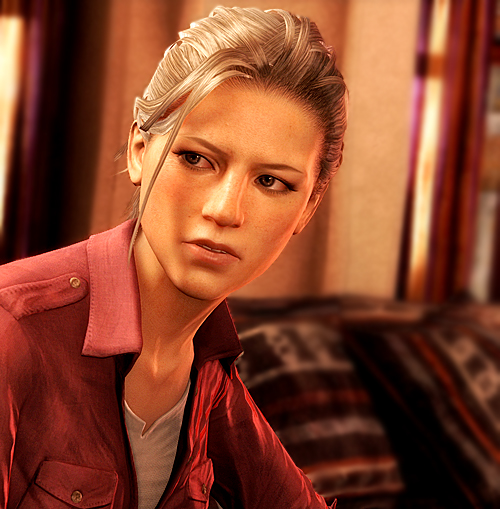
For our purposes today, I will be extracting the background out from behind the beautiful and talented Elena Fisher, because she's an awesome character and can always use some more love.


Looking pretty good there Elena. Thank you to Google Image Search for this. Also thanks to Naughty Dog for the character and game graphics, along with the rest of Uncharted 3.
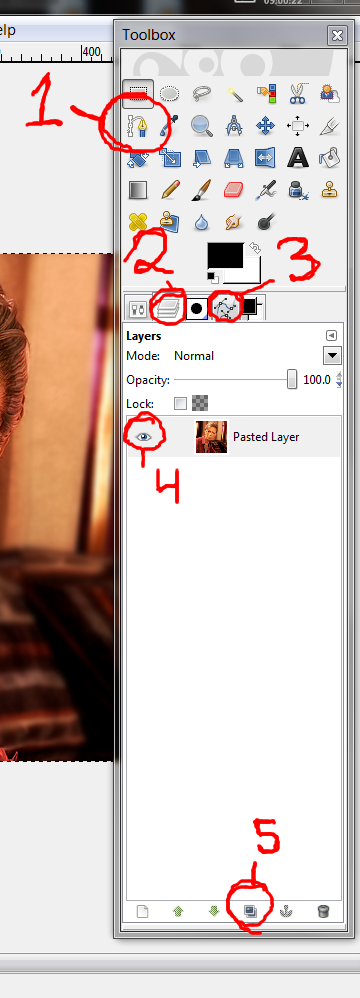
Now let's look at our Toolbox.


There are 5 objects labeled on that image.
1: This is the Pen tool, also called the Paths tool. It is the key to victory.
2: This is the layers tab. All of these little tabs do not appear by default - the only one that should be there by default is Tool Options. See that little arrow to the right side, the one pointing the left? On the image, the arrow is on the same row as the word "Layers". Click that, hover over the Add Tab option, and select Layers. Repeat the same procedure with Paths.
The Layers tab is important to setting up! It shows all of your current layers and allows you to do things with them. If there's one thing that puts MS Paint at the bottom of the stack of art programs, it's the program's inability to do layers.
3: This is the paths tab. I already explained how to get it. It shows all the paths you have currently created and lets you do things with them. We'll actually only need it briefly.
4: This little eyeball icon is a layer's visibility. Clicking on it will make the layer disappear! This is mostly only important for a back-up step of mine.
5: This is the duplicate layer button. It is also only necessary because of a back-up step.

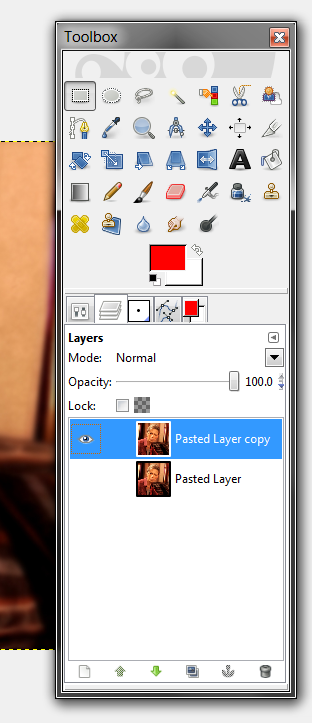
In fact, let's do that back-up step. Regardless of what I plan to do with an image I'm manipulating, I like to keep a copy of the original in case I need it for something. You could of course just save another copy, but this keeps it close, and it's really easy.
In the layers tab, select your one layer, click the duplicate layer button. You should now have two layers, exactly the same. Now, click the eye next to the layer on the bottom, making it invisible. When you're done, it should look like this:


Now is a good time to save. Now, you can't quite save as a flat image file yet - you want to keep all those lovely layers. GIMP has a native file type called .xcf. Save your image as whatever_you_want.xcf.
Here's an important note: you cannot upload .xcfs to the internet as images. It has no idea what to do with them. Only GIMP understands how to open .xcf files.

Let's teach how to use the Paths tool. Select it. No need to follow along with what I'm doing here though, this is a demonstration.

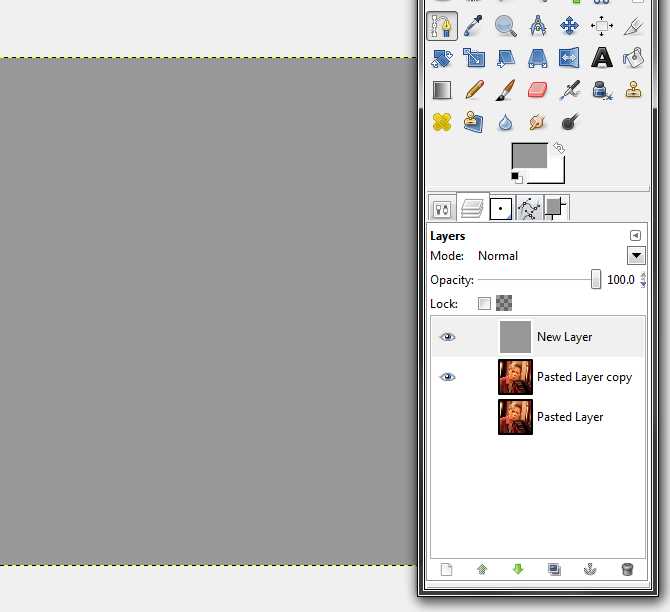
I've created an all-grey layer over Elena. Sorry Elena, we'll be seeing you again in a second!
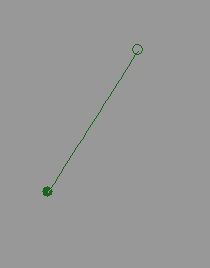
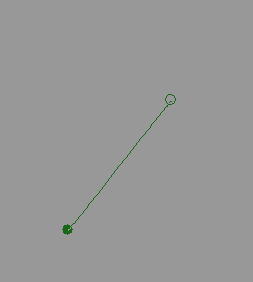
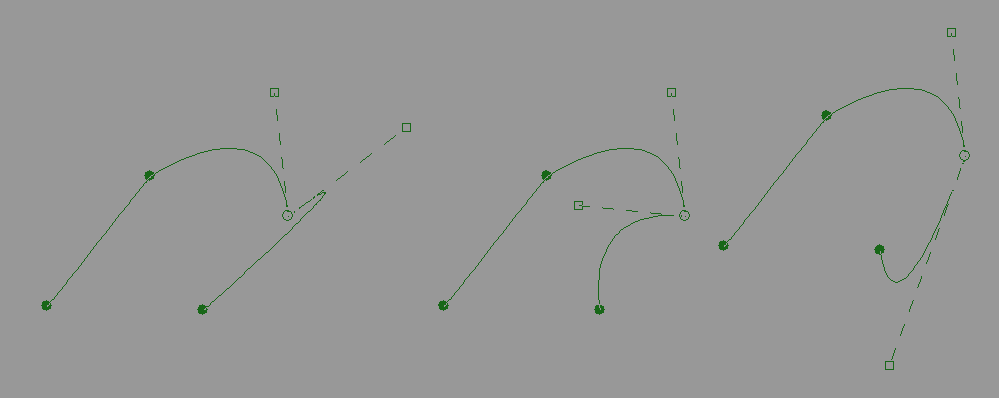
Here's the basics of how the Paths tool functions. When you click the first time, you create a point.
Like this.

That's one point. Now I make a second point!

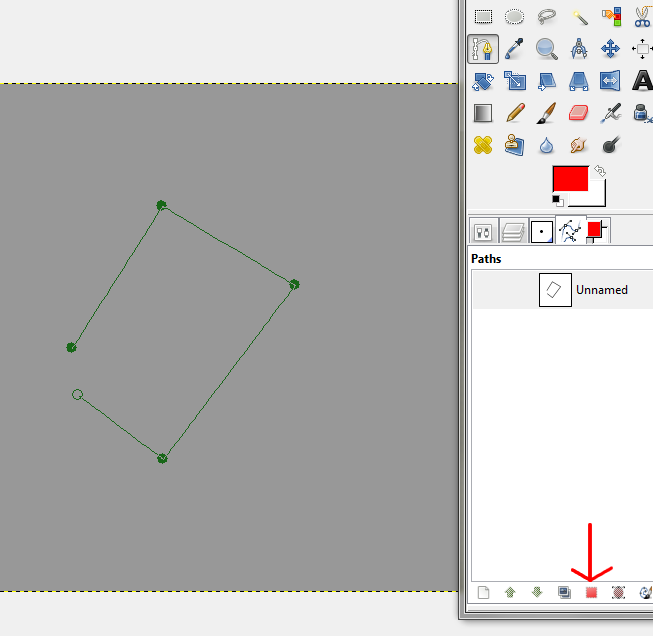
See how a straight "path" has been formed between them? Now I think I'll make a few more paths real quick... I'm going to be on the Paths tab now by the way.

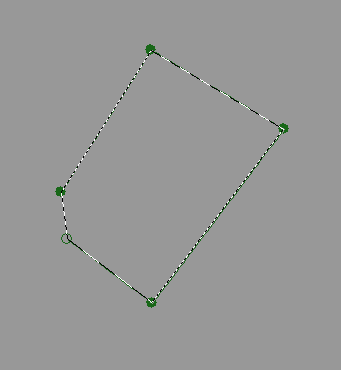
Now I have a bunch of lines in this path. See that box that I'm pointing at with a red arrow? That's the Path-To-Selection tool. It creates a selection, running along the path, connection from the first point to the last point and acting as if there was one more line connecting the first and last points.

I clicked the button. The dotted line, which is animated in reality (I'm not high-quality enough to actually make a gif of it), indicates a selection. Until I end the selection, I can only effect inside the selection. I can do things like fill it with color:

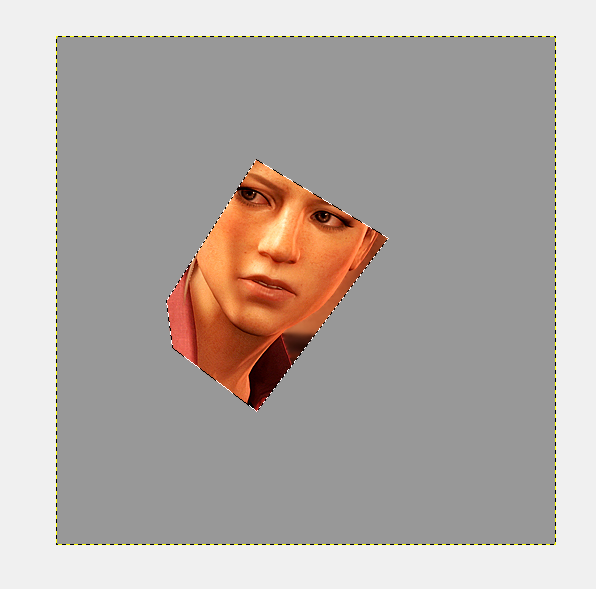
Or, critically, I can DELETE everything I currently have selected by, uh, clicking the delete button on my keyboard:

Hello Elena! When I clicked Delete, what technically happens is everything I "deleted" is converted to transparency. Because my duplicated Elena layer is still marked as visible, when I delete parts of this top gray layer, the lower layer shows through. If I delete elements of that duplicate Elena layer though it will turn to actual transparency, because there is no visible layers beneath it.
Let's show off the reasons I like using the Paths tool though.


What's the difference between the left and the right? The left was done with the paths tool using the above technique, while the one on the right was done with just the regular old eraser tool in like 5 seconds.
If it isn't popping out at you, look at the edges. On the paths tool, it looks like they're blending together a bit! But they can't be, they're on different layers, they don't interact! This happens because the very edges of the Paths Selection doesn't fully turn to transparency. Instead, they leave the very edges in a state of PARTIAL transparency, allowing a bit of it to show through. This is why I like Paths, they make a super-smooth look. And because it's NOT blending but partial transparency, it means it will blend that way with anything you put under it.

The other thing the Paths tool excels at is curves. Let's fill in the canvas with grey again and place two points just by clicking.

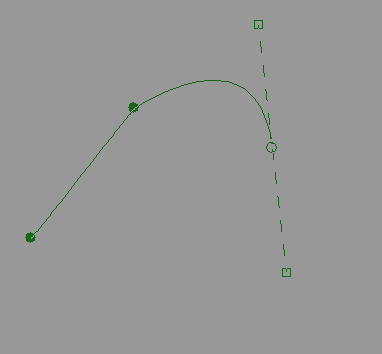
Now, I could place a third point the same way, but let's do something slightly different. Instead of just clicking, I'm going to click and hold it and then drag off to the side, THEN unpress.

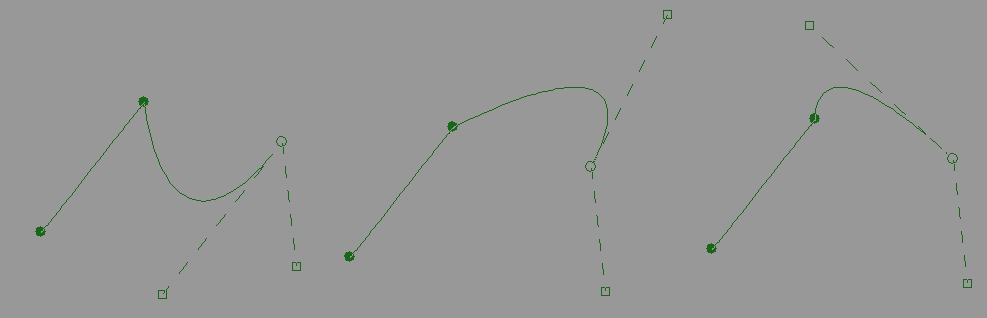
Woah! A curve. I pulled it downward, and where the little box on the bottom is is where I let go. The top box always moves in the exact opposite direction of where I move the mouse while holding it in that initial pull. Now I can click and drag that top box around to CHANGE the curve. Here's a couple.

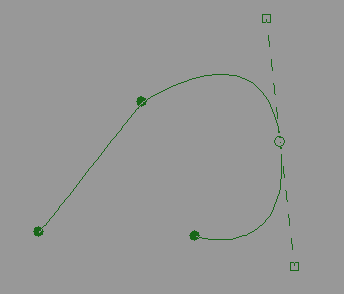
So, that other box doesn't change. What is it for? It impacts the next curve in a sequence. Here, look at this:

That's the original path (the first one there, all alone) when I made a new point. Important to know is that I did NOT hold and drag that one! If I had made that path off of, say, the first point, it would be straight. All the effect is from the bottom box, the previous curve informing this line. Let's move that bottom box around a little.

Moving it around only affects the next curve, not the previous one. So the two boxes let you influence the curves on either side of the point. Messing around with them gives you all sorts of control over your curves. Experiment a little to get a feel for it!
Now let's stop messing around in this grey layer. I'm gonna delete it and look at Elena some more.

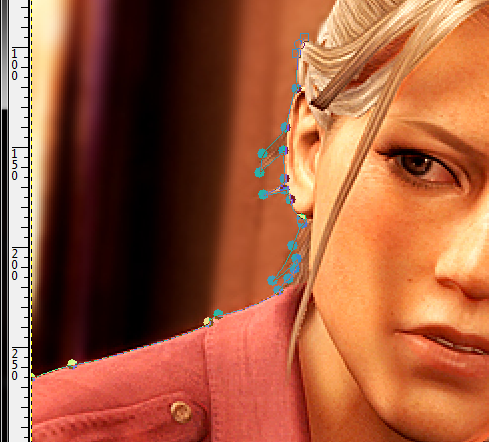
Alright. So I'm going to zoom all the way in on the image and move over to where I'm starting, at the spot where her shoulder goes off the edge of the image. Make your first point at the very edge. Heck, maybe even put it a little over the edge of the image.

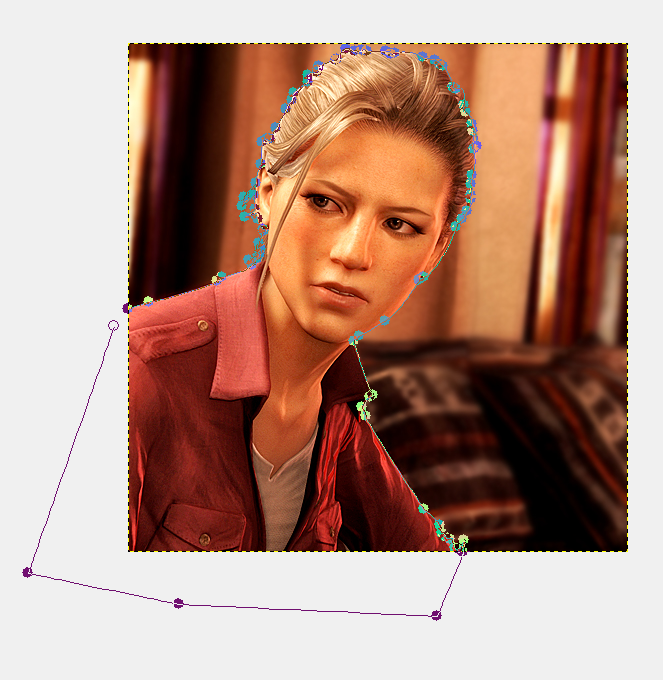
Here's me as I'm working along the side of her head, zoomed out a bit. Pull out those little boxes and move them around to make the curves match the image as you go, and know that whenever you want a sharp turn, take the box that affects the next curve and place it on top of the point - it won't have an impact. Don't worry about it being absolutely perfectly matching every little curve - too many little dips might be accuracte, but will cause a rougher line. I like to avoid having any straight lines if I can, I find they don't match well.
Hair is one of the hardest bits to do because of all the loose strands and layering and it's a complicated visual tangle. Use your best judgement to decide which bits to pick out. I'm serious, hair is one of the hardest parts of any render.

When I hit the edges I usually just go wide around it. They don't matter.
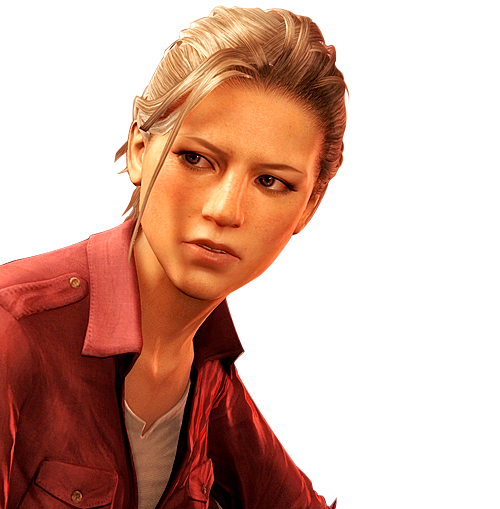
So select the image with that Path-To-Selection button! You might notice that we have a slight issue - if you hit the delete button, you delete Elena and leave the background! That's the opposite of what we want. And so, once Elena is selected, let's Invert the selection. You can do this by going to Select -> Invert, or by pressing Ctrl+I. Then hit delete.

I checked it over a whole bunch of backgrounds and it looks pretty good in them! Of course, this isn't perfect. I did it in 5 minutes after all. But it's passable, and it's not all messed up, and if it's shrunk down for an avatar or something it'll look great.

So let's talk about troubleshooting real quick.
Your go-to fix is Ctrl-Z or Edit -> Undo. GIMP's limit of undos is super high.
If you change your tool off of the Paths tool by accident, it looks like your path disappeared! But don't panic, it's not gone. Select your Paths tool again. Now go to the Paths Tab in your Toolbox, and you should see it there! Remember how those eyeballs mean visible? Well, your path is currently invisible. Click on the left of the path you want (if you get a chain, try a little further left). You should now see the line of the path on your image. If you click that line with the paths tool, your points should reappear. Just remember later to make the path invisible again or the image won't look right later.

And just as a bonus, I messed around with the colors of the final image. That scene in the game had HEAVY red and yellow lighting, I wanted to tone it down a little into a more toned-down image.

Colors like that, she could jump right in with her voice-actress sister over in Haven. (I love you Emily Rose)

Hope you learned something. It takes some practice, but this is a pretty strong technique for extracting stuff due to the versatile shapes of paths and their sharp-yet-smooth edges. I make most of my digital art with paths these days.
Later folks.
End Recording,
Ego.

Wednesday, January 15, 2014

Video Games: Dysfunctional Systems Chapter One (and also other VN talk)


The music, much of it done by a cool person called CombatPlayer, is a really great part of Dysfunctional Systems. Purchases come with the soundtrack by default, and it stands up decently for independent listening, which is really cool. Also, this is the intro video for the series, it's great. At the end you can hear a brief excerpt of Terminus, the theme of Episode 1.

So I played this game Dysfunctional Systems: Chapter One, Learning To Manage Chaos the other day. OR, well, okay, game might be a bit strong. Dysfunctional Systems is a Visual Novel. So what the heck is that? My best explanation is that it's a cross between a choose your own adventure book and a comic book. It's a story, and you read the dialogue boxes full of conversation and narration, and you read a lot of it, and occasionally there are points where you can make decisions that branch the story in different directions! There's graphics on the screen, often character portraits, and they move or change expression appropriately, though rarely with any major degree of animation. Music plays. It's like reading a movie that you occasionally determine the path of.

Other than choosing the path, there's no gameplay usually. That's why I struggle to define visual novels as "games" but I open them with Steam and you interact like a game, so I guess that's the best fit.
(and I don't mean to degrade them or anything as "that's not a real game," I like 'em, they just make categorization a bit tougher)

Oh, and while VNs have a reputation for ero / romance stuff, and that makes up a very large percentage of the medium, I haven't played any of those.

So I don't have much experience with Visual Novels. But I really liked this one! It has a cool premise, and all the bits are executed really beautifully.

Hoodie dresses forever.
This is Winter Harrison, our protagonist. She is a 14 year old mediator-in-training. In this game, Earth civilization has progressed to utopia - she has no foundation for the idea of war, deadly sickness, oppression, or murder. Earth has managed to create the technology to enter different planes, where stuff is not quite as rosy. Mediators travel to these places to eliminate chaos - not to right wrongs necessarily, as establishing order is not always are good.
In the game, Winter has been beamed to a former colony that is still ruthlessly oppressed and exploited by the mother country, despite legal independence. She is being towed along by a mentor, Cyrus. They are there to fix detected impending chaos in the world.

I won't spoil more. It's really good. Regardless of the path you choose, there are two major ending types, and even those two have the same general events play out, just with wildly different character relationships at the end. The game has this kinda funny cute tone to begin with, but gets all serious and dramatic and interesting very quickly. More than anything else, it does setup for the future while current stuff is also happening. They have a great framework built.

Confusing thing: pacing. You get the fully-animated title sequence thing about an hour in, which is about fifteen minutes from the end of the whole thing. This kinda makes sense - it's a Chapter 1! The problem is it doesn't make much sense for Ch1 as a standalone release, which it's going to be for a while. Unfortunately, Dischan simply didn't make enough cash off of it to continue development right now. They've axed over half the staff and have put Dysfunctional Systems on indefinite hold while they figure out how to have money. Sad. I really liked what they had going.

So, uh, go buy their thing. It was on for like $2.50 last week, which is why I bought it - it looked pretty and I figured the premise sounded cool enough that I could pay the same as a cup of tea for it. It's always $5 otherwise, which is still decent. Heck, it's even on the app store.

HERE IS A LINK TO THE WEBSITE. GO BUY IT IF YOU LIKE SCI-FI STORIES.

This was the first time I intentionally bought a visual novel. I guess I had a vague idea the last time, when I bought Analogue: A Hate Story and its sequel Hate Plus at PAX, but that was mostly just based on them sounding cool on an impulse. Those are also amazing and you should go play them, though they're not quite as easily-accessible as DS.
Also, well, I guess the Phoenix Wright games are basically visual novels with more interaction. But I definitely didn't think of them like that when I bought them.

So, are there like any other Visual Novels out that I should really go play? I have no idea what to look for in this field. I've played 999 and want to play Virtue's Last Reward, and I would want to play Steins;Gate if the anime wasn't so thorough in its amazingness, but I'm really clueless here.
Also, I'll probably draw some more Dysfunctional Systems sometime. Winter is fun to draw.

End Recording,
Ego.

Friday, December 27, 2013

Schoolwork: Cultures, Experiences, and Human Connections: The Benefits of Analog Tabletop Roleplaying Games to the Teaching of History


When I heard Brian Tyler was replacing Lorne Balfe as Assassin's Creed composer, my heart soared, given that I love his recent work on Fast and Furious 6 and on Now You See Me. He didn't disappoint. This is an awesome soundtrack, though he didn't keep Kyd's "first civilization" sound even for the modern stuff like Balfe did, but that's an okay tradeoff. 
I got the game for Christmas and holy cow, just the sheer volume of content is making me head spin. This is a great game, and seems to have completely sidestepped the issues Assassin's Creed 3 had. That's what I've been doing for the past two days. Yesterday I did nothing by play Black Flag. I'm surprised and overjoyed by it.

This is my biggest and favorite essay of the three I've been posting, mostly because it directly pertains to things I've already shown interest in. Let's give some backstory real quick:
I was not technically in the Vikings class I attended or wrote those other essays for. I was actually in HIST493, which is a History Independent Study course, essentially allowing me to take the Vikings class as an upper-division course if I did some extra work. This essay is the extra work. I have taken multiple other classes with this professor, and something we've talked about a few times is games and their potential within teaching - we've especially talked about Assassin's Creed. As this Viking class had us reading Njal's Saga, I thought it would be good to show him Sagas of the Icelanders (the game), and he thought it was interesting. So we decided I could do my extra paper on RPGs. I was originally also going to talk about video games, but, uh, that's gonna have to wait, because both time constraints and also the fact that the essay is already giant stopped me.

Now, this was written for people with no experience with RPGs or their terminology. I occasionally lapse out of the formal style for writing history papers, and lack footnotes (though I have a brief bibliography containing the three games I discuss). The three games are Sagas of the Icelanders (which I have both played and run once each), Montsegur 12444 (which I have played once), and Dog Eat Dog (which I have not played).

Basically, I'm really interested in discussing this further. I know we have a number of teachers in the RPG community, but most stuff I've seen such as Ruthless Diastema podcast tends to hit at a primary school level which is important but also a very different context from university. I'm also interested in seeing if others agree with what I'm saying about these games.

My professor and I have been talking about taking this further, essentially co-authoring a more complete paper on the subject of games and the instruction of history (probably, he says, through mocking up an imaginary course syllabus for the subject). Ideas?

Anyway, here's the disclaimer and the paper.

As usual, this is my essay, made available so I can potentially receive feedback and to help others learn what I'm learning myself. I'm no expert, so seriously, none of the would-be paper thieves out there should use or even cite this. Still, I think I learned a lot to be able to write the essay, and hopefully you learn something too!
And if you know something about the subject, let me know if I got something right/wrong, or if you have interesting insights or thoughts about it! Same with folks who know things about writing essays! And I do love hearing when just other regular folks get some education out of my work.


Max / Ego                         Vikings Independent Study Individual Essay
Cultures, Experiences, and Human Connections: The Benefits of Analog Tabletop Roleplaying Games to the Teaching of History
            For many, games are an important part of everyday modern life. These games take many forms. Sports, specialized media forms like video games, commonly-hold social board games, games of chance like the Lottery or the myriad card and dice games played at casinos, and even many everyday tasks not conventionally considered games are being game-ified, adopting elements like points and competition. The simple reason behind this is that games are fun! People like playing games, but often like games even more if they can get something out of it. For this reason, game designers are always looking for ways to reward the player.
            The oldest games we have available to us were created completely in the abstract. Tic-tac-toe, Go, and Checkers are all exchanges in simple game terms rather than representations of anything. This tradition of game design is still visible in many board games, and in the lottery and card games. From these, the rewards that can be provided are limited in nature: improved skill and strategic thinking, and money (in the form of betting within card games or the lottery). Little else can be achieved with these basic games. The next level of games is ones that are metaphors for some other activity but still function completely without reference to these activities. Sports are ritualized combat, and Monopoly is a game about being a real estate tycoon, but take those elements away and they remain sturdy, playable games. In these you get the same benefits as from abstract games (skill, betting money) but also gain a greater understanding of the concept being symbolized by the game, albeit only at a conceptual level. The third level of games build on the idea of a game as a represntation of something else and makes it fundamental to playing the game itself, where removing that representation changes the nature of the game itself. The most common form of game in this category is the role-playing game. Both pen-and-paper roleplaying games (henceforth referred to as RPGs) and digital video games rely on the concept of playing a game where one’s character is different from themselves or where the setting is different from our own, or both. These types of game have unique applications in augmenting or enhancing the teaching of history. Games are excellent tools for teaching specific elements of history, though caution must be exercised to understand when liberties are taken to achieve the game’s other agendas. For these purposes I will be looking at several major historical fiction RPGs to analyze their value to history education, predominantly focusing on Sagas of the Icelanders, Montsegur 1244, and Dog Eat Dog.
            First, a quick explanation of how pen-and-paper RPGs (also called tabletop RPGs) function is warranted, given their relatively small imprint in popular culture. Now, explaining these games as a whole is akin to trying to explain all sports with one description – difficult, full of exceptions, and largely unhelpful when going beyond the basics. However, a unified factor of almost all RPGs is that they are social games. To play, you gather together a small group of friends (usually 3 to 5 people), along with the rulebook to the game and whatever else the game requires (oftentimes dice, sometimes six-sided and sometimes a bit more exotic). Players then use the rules to facilitate a conversation between them, exploring the actions of their characters, the consequences of those actons, and ultimately creating an original story. In this way, playing an RPG is a lot like a collaborative storytelling session or improvisational acting, but facilitated by a set of rules adding uncertainty, drama, and surprise to the story. The important thing to know is that the game is an interaction between a group of friends and the designer via the rules, but with the friends taking the active role in the game.
            The first RPG to discuss is called Sagas of the Icelanders, by Sloveian game designer Gregor Vuga. Self-described as a game about “the trials, tribulations, and adventures of the first settlers of Iceland, as described in the Icelandic Sagas,” the game strives to “paint a believable picture of saga-period Iceland,” though the author quickly highlights that he uses “the word ‘believable’ and not ‘realistic’ or ‘accurate,’” with the goal being to “create fiction in the historical cotext, not recreate it.” This is the assumption one must make with this social game, where the group of people playing cannot be expected to be experts in the field (otherwise the game would pertain only to RPG players who are Sagas-period experts, which is a niche audience indeed). In order to allow even completely unknowledgable players to create that “believable picture,” the designer of the game had to build the game’s rules to do the heavy lifting.
            Now, in order to accommodate players who are not all are experts or who lack even one person versed in the historical truth, the game cannot take out a large chunk of time to explain the way things were, and the rules cannot model every single facet of the Sagas. Instead, the game has to distill out what the author considers to be the important elements of the Sagas to model within the game. This is one benefit of using an RPG as an initial learning tool – the elements pulled out of history to create the game can provide a strong picture of what is unique, special, or different about that part of history. In Sagas of the Icelanders, the game singles out one major theme to flavor the entire experience of the game: gender politics. The game goes to extensive lengths to represent the divide in gender roles iconic of the Vikings, especially where those roles are furthest from our own societal understanding of gender roles. That representation of the gender gap will be apparent in many elements of the game, but especially in the Rolebooks, Stats, and Moves.
            In Sagas of the Icelanders, all but one participant play one character, who is theirs to control and make decisions about (the remaining participant is the Master of Ceremonies, who is in charge of playing all the remaining characters and putting obstacles in the players’ paths to make struggles real and rewarding). The first thing a player does is create a character, and “the first thing you do when creating a character should be choosing their gender.” Gender is literally the first step of playing the game, and forms the core around which your character is built. After choosing male or female (other understandings of gender didn’t exist in the Sagas, and thus don’t in the game), you choose a Rolebook. Rolebooks are sort of like lists of options with instructions on how many to choose from each list, determining elements such as a character’s look, abilities, and relationships based upon which rolebook was chosen. There are four female rolebooks, “the matriarch, the sei[th]kona, the shield-maiden and the woman,” four male rolebooks, “the go[th]i, the huscarl, the man and the wanderer,” as well as three which could be of either gender, “the child, the monster and the thrall.”[1] This division alone is one of the first ways in which Sagas of the Icelanders pulls out what the important, or at least significant, social roles were for each gender in the Sagas. Looking more specifically at each of the rolebooks, it teaches what it means to be a man, or a go[th]i, or a matriarch in the Sagas. It’s fitting that almost all characters from Njal’s Saga (referenced in the text as The Saga of Burnt Njall – the text occasionally provides quotes from the Sagas to reinforce how the Sagas were or to help evoke the intended mood for the game) can be thought of in terms like these. Gunnar would be a Man, Bergthora a Woman, Skarphedin a Huscarl, Hoskuld Thrainsson a Go[th]i, old Gunnhild a Sei[th]kona. This division of rolebooks has a couple effects. First, it does a good job of breaking down the categories that characters fall into, even if they don’t have that title in the original Saga. Njal, for example, is best modeled as a Go[th]i, based on his legal mastery and influence and his less-than-manly appearance by the cultural standards. By dividing the rolebooks without hierarchy however, the importance of some may be overstated. While the game calls out that “The Man and The Woman should take precedence before the other rolebooks,” the Shield-maiden is positioned to be just as common in games as the Go[th]i or Huscarl, which isn’t true in my experience of the Sagas (primarily Njal’s Saga) though a cursory glance at the internet informs me that they may have played a larger part in other sagas such as the Saga of the Volsungs, which while it would reinforce the strength of the list of rolebooks doesn’t change the fact that it is otherwise without prioritization of various roles an inaccurate picture of the Sagas may form. Ultimately this is only a small problem, as the Sagas themselves differed greatly in the demographics of featured characters. The list also precludes the idea of crossing the gender line; for example Svan, a magic-wielding man from Njal’s Saga, would be a male Sei[th]kona, which is outside of the scope of the game. This distinction is a double-edged sword. On one hand, it fails to reveal that element of society to new players. On the other hand, through the Sagas those who totally violate those gender barriers are portrayed as villains (Svan for magic, Mord for treachery and dishonorableness, Hallgerd for boldness and refusal to be subservient), and as the players’ characters are protagonists it would be inappropriate for them to be crossing such boundaries.
            If the rolebooks determine what sort of person a character is in a general sense, then the Stats exist to define the character’s personality as an individual. Put simply, Stats are an attribute of a character that range from -1 to +2, with higher values meaning that a character has more of that aspect in their personality. The four personality attributes that Sagas care about are “Young, Versed, Gendered, and Wyrd.” Young means fierce, strong, hot-headed, and the like, Versed implies experience and training, Gendered is about how well a character plays into their gender role (with a negative value not representing crossing over boundaries so much as simple ineptitude at things they are expected to do as a man or woman), and Wyrd marking the lucky, odd, or set apart. These four things have historical context and teaching behind them as well: they’re a simplification of the lines along which people were judged in the sagas: energy and enthusiasm, skill, (wo)manliness, and ordinariness. To take a couple of characters from Njal’s Saga and judge them by this system, Njal could be interpreted as +0 Young, +1 Versed,             +0 Gendered, +1 Wyrd, which, fittingly enough, is a stat line available to the Go[th]i, determined above to be the best rolebook for Njal. Gunnar could be +2 Young, +0 Versed, +1 Gendered,      -1 Wyrd, which is available to the Man rolebook picked for him earlier. The stats show a fairly good picture of the various important elements to characters in the Sagas, but are again limited by the fact that they are definitely a simplification of the truth in order to prevent confusion by the players.
            The third main element by which the game makes clear to its players what it means to be in 10th Century Iceland is the moves. Moves are a game term for the dice rolls in the game. Each move has a ‘trigger,’ indicating when you should roll the dice. When a player, in the course of the conversation of play, says that their character does something and the action aligns with a move’s trigger, you follow the instructions in the rules, rolling dice and then interpreting the results. While what happens as a result of specific moves is revealing, and that will be dealt with soon, the most important part to look at when analyzing the game’s value as a teacher of history is actually in the triggers. This is because the moves and their dice rolls are the heart of the game – they signify what actions are important in the game, and reward players who do them by making the game surprising and unexpected. They are the only time when the rules and the conversation of play and the rules of the game interact for players. Now, the list could theoretically be comprehensive, accounting for any action that might fail, but Sagas of the Icelanders instead opts to only provide moves that reinforce the feeling of playing out your own Saga. Here are some examples of moves that anyone can trigger: “When you endure grave harm,” “When you give someone a gift,” and “When your character survives a winter in Iceland.” These are actions that define scenes in the Sagas, and thus they are the actions chosen to define the game. However, beyond the common moves that can be triggered by any player, there is also a category of moves specific to each gender. The selection of these moves, even moreso than the rolebooks, define the different ways the genders act. Some of those female moves include “When you entice a man,” “When you raise your voice and talk sense,” and “When you goad a man to action,” all things definitely done by characters in the Sagas that are iconic of woman and inappropriate for men to do. On the flipside, some male moves triggers are “When you throw an insult at another man,” “When you honor is in question,” and “When you accept a physical challenge,” which are similarly defining of mens’ actions in the Sagas. The trouble here is the same as with rolebooks and stats, that they are a simplification to make play easy at the cost of historical comprehensiveness and that they deny the ability to violate the gender barrier.
            On the topic of moves, an extra part should be addressed: the additional moves in the back section of the book. Depending on what sort of game of Sagas of the Icelanders you’re playing, groups might bring in special sets of moves that represent elements of Icelandic society that are not necessarily important to all games of Sagas (and thus are relegated to the back to increase the accessibility of the main game). These refer to specific parts of society; for example, there is a section on religion (with extra moves like “When you accept the gospel of the White Christ” and “When you die a pagan”), on warfare and violence (with “When you fight with many against many” and “When you endure great harm during a holmganga duel” as a couple example moves), and on law at the Quarter Courts at the Althing (with move triggers like “When you rule against your Go[th]i or a member of your family” and “When you speak the law before the assembled host”). In this way, games might address topics important to the Sagas in a more rules-mediated (and thus more structured) way, allowing for the game to not only be more suited to what the players are interested in exploring (maybe a group doesn’t care so much about religion but really likes playing out legal stuff), but also allows the game to be focused to provide a better, more accurate feel for certain aspects of Icelandic society in the Sagas period. Even further attention could be payed to moves, such as the implications each specific move has for bringing forth a genre-appropriate tone (such as how the male move “When you accept a physical challenge” always promotes very fast and dangerous combat rather than protracted fights), but for now it is best to shift to a different game to look at.
            For the next two games, discussion will be kept relatively brief, focusing on the ways they differ from Sagas of the Icelanders in style of providing a historical lens, as Sagas of the Icelanders is generally a good model of how games model history, with simplification and categorization to improve accessibility (though Sagas has an exceptional degree of historical implications and significance baked into its rules compared to the majority of games). In Montsegur 1244 by Frederik J. Jensen, there is no Master of Ceremonies or other controlling figure as there is in Sagas of the Icelanders. Montsegur is a game about the last stand of the Cathars at Montsegur during the Albigensian Crusade. This historical event ended in forced conversion or burning at the stake for nearly every soul inside the nigh-impregnable mountain fortress of Montsegur in the south of France. Every player of the game controls two characters, selected from a batch of characters that come from the game with pre-existing roles within the small village inside the fortress’ walls, such as the unbelieving ruler, the leader of the guard, the head Perfect (a role in the Cathar theology similar to a priest) or a harlot in the town. They play these characters, each of which comes with their own batch of personal issues, and their interactions through a number of scenes structured by the game itself, starting with a “practice” scene of the assassination of a Catholic inquisitor that leads to the main scenes, which take place in several acts about the very beginning of the siege through the very end and the fate of the characters in the aftermath of the fall of the fortress. Scenes are played out in a structured way that makes the tension and complicated-ness of the situation and the all-encompassing fear of God all become apparent in the characters. This is the biggest strength of this game: it takes players from modern societies and places them in the shoes of a group of splinter group of Christianity who no longer exist today and practiced some extremely odd beliefes, the bulk of which are explained to the players as they become important according to the act structure. This group, very often poorly understood thanks to being wiped out by a war-like Catholic Church (the same Pope earlier declared the Fourth Crusade) and being branded as heretics, are difficult for many modern people to understand. This game puts people in those times with Cathar beliefs and allows them to explore the chaos of an almost alien theology. It also provides a substantial experience of what it felt like to be alone and crumbling under the furious weight of a crusading Church, a less-explored perspective for most players. In this way, the game is an exceptional tool for taking on the role of an otherwise difficult-to-comprehend culture, adding weight and even an air of personal experience to learning the topics in a more traditional sense.
            The third, and last, game being fully explored here is Dog Eat Dog, by Liam Liwanag Burke, which is self-described as “a game of imperialism and assimilation on the Pacific Islands.” Dog Eat Dog is not a tale of any particular island or assimilation in the way that Montsegur 1244 is the story of the Cathars at Montsegur. Instead, Dog Eat Dog is about theme and process. The players first describe the Natives of this island and their society, putting in a little information to guide the culture; this is not a real culture but a theoretical one. The players then each get to add a piece of detail about the colonizers, the Occupation. The players also will have Rules, which are unspoken assumptions governing the interaction of the players, and at the beginning of the game, there is only one, this one: “The (Native People) are inferior to the (Occupation people).” One player, always the richest player in the real world, plays the Occupation. All the others play a native, and detail themselves a bit. The course of the game involves playing out scenes of the characters’ responses to the Occupation’s arrival, with conflicts causing tokens to be passed around until the Occupation player has no tokens or the Native players are all out. At the end, if the Occupation is out, they describe why they grant the natives local autonomy. If a Native has a lot of tokens, they describe how they assimilated. If a Native has no tokens but is still alive, they must suddenly be shockingly violent and destructive, then die. The game is stilted at every turn against the Natives; even if the Natives won, the Occupation grants them autonomy, rather than the Natives earning it. This experience is a shocking one overall, but what does it have to do with history? In short, it’s representational of the mass colonization of the Pacific during the mid-1800s. The game provides an experience that still causes discomfort to many, opening eyes to the other side and placing gravity on the teaching of history by making it feel human. And even outside of the context of the Pacific, it can apply to any colonized peoples (the game even calls out that the Teutonic Knights’ ‘spreading’ of religion to Eastern Europe as a potential alternate setting).
            These are three very different takes on how an RPG can teach history. In one, Saga of the Icelanders, a culture is built in heavily into the rules. You may not play a story of law or religion or blood feuds, but you most certainly will play Icelanders in the Viking Age. In another, Dog Eat Dog, culture is up to the players, but the way the story will go follows a few very distinct and organized paths. Either the Occupation will stop bothering to oppress the Natives, or the Natives will be assimilated or killed, but the game could take place on any fictional island or theoretical colonization. In the third, Montsegur 1244, both culture and story are hard-coded into the rules, making the end a forgone conclusion (the fortress will fall) and the experience about the human reactions in the process of a doomed scenario. And those are things they teach: a culture, a lesson, and a human experience. All of them have a common benefit of putting the players personally at stake and making them care. An additional bonus is that the games are often fun! And fun things are much easier to convince people to do, even if they don’t usually like history, making them either an excellent gateway into further interest in the subject or a simple way to deliver information to those it wouldn’t reach.
            But before wrapping up, there needs to be a few notes on the problems inherent to RPGs as teaching tools. A major problem is that they all come with a substantial amount of straight material to just deliver and read. Dog Eat Dog doesn’t really require the setting to get the experience, and Sagas of the Icelanders builds it mostly into the rules themselves, but all require a bit of a debrief at the beginning to explain what’s going on. That’s really just a symptom of a much larger problem, and that’s that the game is mostly limited by what the player knows. In my own games of Sagas of the Icelanders, I’ve brought in some extra things that I’ve learned to spice up the experience more, but that most people wouldn’t know (for example, the value placed on naming weapons in Scandinavian culture). People can come up with all sorts of things, but they’re limited by what they know. Often they’ll bring in ideas they’ve read (I had a player bring in himself as a Christian missionary from Norway after looking up Iceland on his phone before the game and seeing Olaf Tryggvason), but the unfortunate truth is that these games can easily reinforce misunderstandings of how things were. This is what the game’s design is there for, to make the truth matter to the way it’s played, but without an expert it is ultimately a fun, collaborative way to share your own knowledge with your friends, rather than gleaning brand new truths. Again, the game’s rules mitigate this: it doesn’t matter if you didn’t know about it before hand, playing Sagas of the Icelanders ensures that you will come away understanding something about the gender divide in Sagas-period Iceland.
            In the specific context of a history class, there are benefits and issues. The presence of an expert is unimaginably helpful, for all the reasons above. Of the learning objectives for the Pacific Lutheran University history department, the final two are present and exceptionally well-achieved by the games, those goals being to “develop the ability to determine…the magnitude and significance of historical changes that take place within a society or culture” (which is most certainly a facet of Dog Eat Dog and Montsegur 1244) and to “develop the capacity to recognize diversity, complexity, and the moral dilemmas inherent in the study of history.” Unfortunately, they are bound by two unconquerable elements: player count and time. Each game has a specific range of players it can accommodate, almost always between three and six, and they also take between three and five hours to play a session, ruling them out of an ordinary class structure. However, they might make an excellent side activity for interested parties looking to gain a deeper understanding of a subject. Overall, RPGs form a complex picture of how games can aid in the instruction of history. They can teach the particular elements they were designed around very well, but break down when taken outside of that very specific intention or if interest goes much deeper than a surface understanding of what is being taught, and are bound by inherent structural limitations on participation and time. They differ significantly from video games in many ways, primarily the designer’s role in teaching, the singular experience (as opposed to a social experience), and the audiovisual component not present in the predominantly oral RPGs. Despite their complications, games are a growing part of our culture and the scholastic applications of these games to the teaching of history cannot be ignored, and this examination of Sagas of the Icelanders, Montsegur 1244, and Dog Eat Dog only scratches the surface of the realm of games with relevance to history.


A Brief Bibliography:
·       * Sagas of the Icelanders was written by Gregor Vuga. A PDF of the game is available for 6 Euros here: http://redmoosegames.bigcartel.com/product/sagas-of-the-icelanders-pdf
·       * Montsegur 1244 was written by Frederik J. Jensen. A PDF of the game is available for $12.00 here: http://www.lulu.com/shop/frederik-j-jensen/montsegur-1244/ebook/product-17436348.html
*       * Dog Eat Dog was written by Liam Liwanag Burke. A PDF of the game is available here for $10.00, or a physical copy of the game for $15.00: http://liwanagpress.com/dog-eat-dog/


[1] Where the character Eth was present it was replaced with [th] because I don’t know how to type the original character, which is used in the original text. This replacement will persist throughout the essay.

End Recording,
Ego.